

Table of Contents
- Why Locally Baked Sourdough Beats Supermarket Loaves
- How to Identify Authentic Sourdough at a Glance
- Health Benefits of Sourdough Bread: What the Fermentation Does
- How to Store Fresh Sourdough Bread So It Lasts
- Finding a Local Sourdough Bakery in Toms River, NJ
- Kosher, Shabbos-Ready, and Delivered Fresh: What to Look For
- Frequently Asked Questions
Last Updated: September 28, 2026
Why Locally Baked Sourdough Beats Supermarket Loaves
Walk into any grocery store and you'll find "sourdough" loaves stacked on shelves, priced low and wrapped in plastic. Look closer at the label, and many of them list commercial yeast alongside a pinch of sourdough culture for flavoring. That's not real sourdough. Learning why choose locally baked sourdough bread starts with understanding what you're actually buying, and at Isaacs Artisan Sourdough in Toms River, NJ, we've built our entire bakery around that distinction.
Locally baked sourdough is bread leavened entirely by a living culture of wild yeast and bacteria, fermented slowly and baked in small batches near where it's sold. The difference shows up in the crust, the crumb, the shelf life, and how your body handles it.
The Label Problem: What 'Sourdough' Means on a Supermarket Package
The word "sourdough" on a package carries no legal definition in the United States. A manufacturer can add a small amount of dried sourdough powder to a fast-risen commercial yeast dough and still print "sourdough" on the front of the bag.
A common mistake shoppers make is trusting the word alone. Flip the package over instead. If yeast appears in the ingredient list, you're holding a conventional loaf with sourdough flavoring, not a fermented one.
What a Real Small-Batch Bakery Does Differently
A genuine bakery ferments its dough for hours, often overnight, using only flour, water, salt, and a maintained starter. That long fermentation is where flavor, texture, and digestibility come from.
Small batches also mean the baker watches each loaf. Timing, hydration, and oven temperature get adjusted by hand rather than by a factory schedule. You can taste the difference the first time you slice into one.
How to Identify Authentic Sourdough at a Glance
Authentic sourdough looks and reads differently from its mass-produced cousin. Three quick checks will tell you what you're holding before you ever take a bite.
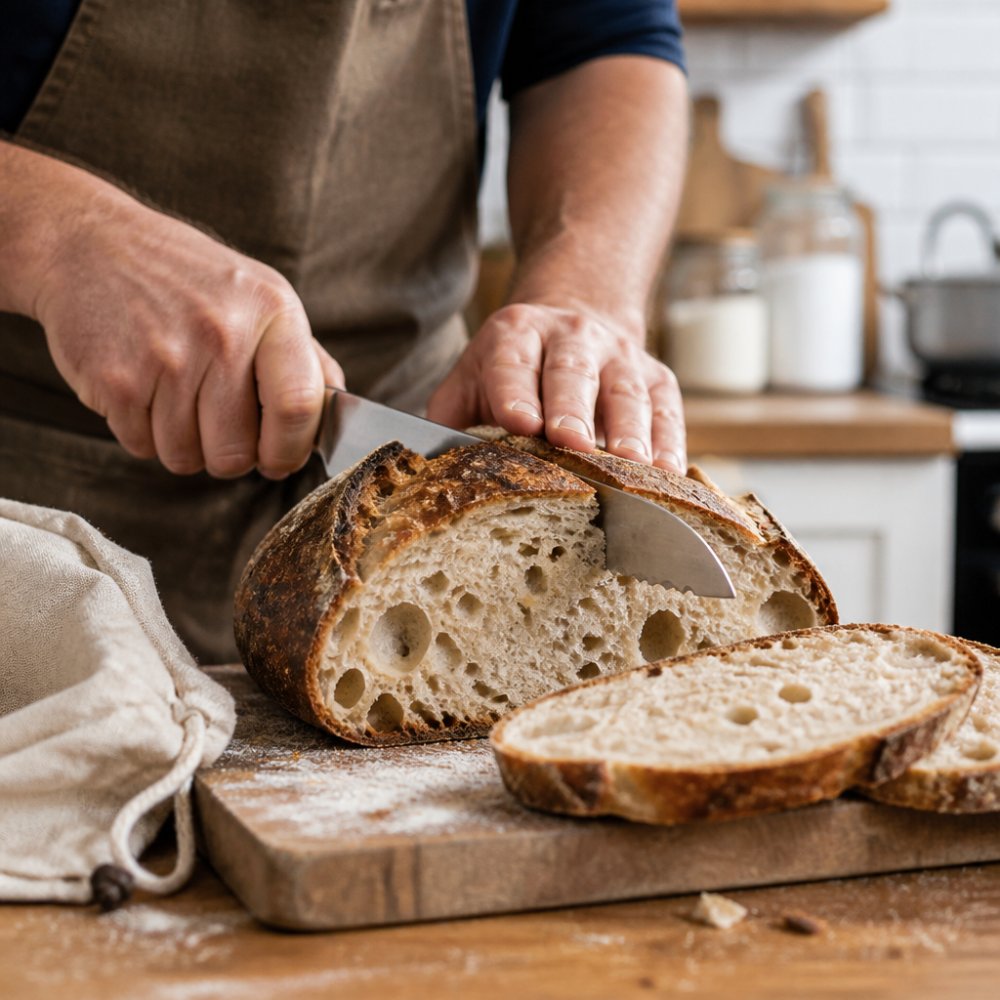
Three Checks: Crust, Crumb, and Ingredient List
Crust: Real sourdough has a deep, caramelized, slightly blistered crust that crackles when you press it. Pale, uniform crust usually signals a fast rise.
Crumb: Cut a slice. Authentic sourdough has an open, irregular crumb with visible air pockets of different sizes. Tight, uniform, cake-like interiors point to commercial yeast.
Ingredient list: This is the fastest check. Real sourdough lists flour, water, salt, and culture. If yeast is on the label, it isn't long-fermented sourdough.
| Check | Real Sourdough | Supermarket "Sourdough" |
|---|---|---|
| Crust | Deep, blistered, crackles | Pale, soft, uniform |
| Crumb | Open, irregular air pockets | Tight, even, cake-like |
| Ingredients | Flour, water, salt, culture | Often includes commercial yeast |
| Rise time | Hours to overnight | 1-2 hours |
Health Benefits of Sourdough Bread: What the Fermentation Does
The health benefits of sourdough bread come directly from fermentation, not from the flour alone. During a long ferment, wild yeast and lactic acid bacteria begin breaking down components of the grain before the bread ever reaches your oven.
That pre-digestion is why many people who find conventional bread heavy report that real sourdough sits differently. The USDA FoodData Central database is a useful reference for comparing the basic nutritional profile of bread types.
Digestion, Blood Sugar, and Nutrient Absorption
The fermentation process partially breaks down phytic acid, a compound in whole grains that binds minerals like iron, zinc, and magnesium and keeps your body from absorbing them efficiently. A longer ferment gives those enzymes more time to work.
Many home bakers and health-conscious eaters also notice that sourdough feels easier on the stomach than fast-risen bread. The lactic acid produced during fermentation is one reason, and it's a big part of why traditional breads have stayed popular for centuries.
How to Store Fresh Sourdough Bread So It Lasts
Knowing how to store fresh sourdough bread matters because a real loaf has no preservatives doing the work for you. The goal is to keep the crust crisp and the interior from drying out.
- Days 1-2: Keep it cut-side down on a wooden board. The crust stays crisp and the crumb stays soft.
- Days 3-5: Move it into a paper bag or a linen bread bag. Plastic traps moisture and softens the crust into leather.
- Longer than 5 days: Slice it, wrap it tightly, and freeze it. Toast slices straight from frozen.
- Never refrigerate: Cold temperatures speed up staling. The fridge is the worst place for a loaf.
Finding a Local Sourdough Bakery in Toms River, NJ
Searching for a "sourdough bakery near me" in Toms River usually turns up grocery aisles and chain bakeries first, but the loaves worth your time come from small producers who bake on a real schedule.
When you're evaluating a local bakery, ask three questions: How long is the ferment? Is the starter maintained in-house? And is the bread baked the same day it's sold or delivered? A bakery that answers those clearly is usually one that takes the craft seriously.
Isaacs Artisan Sourdough bakes small-batch kosher sourdough in Toms River and delivers it fresh weekly, so you're not chasing a restock schedule or settling for whatever's left on the shelf. Our Classic Loaf is the signature naturally fermented loaf, and it's the easiest place to start.

Kosher, Shabbos-Ready, and Delivered Fresh: What to Look For
For families keeping a kosher kitchen, "fresh" and "certified" have to be true at the same time. A loaf can look beautiful and still not fit your standards.
Look for clear kosher certification and a Pas Yisroel designation, which confirms a Jewish baker was involved in the baking process. Yoshon status matters too for those who follow it, and Pareve labeling keeps the bread flexible for any meal.
Isaacs Artisan Sourdough bakes Pas Yisroel, Yoshon, Pareve loaves, including the Jalapeño Loaf, Olive Loaf, and Garlic Loaf, all delivered on a weekly schedule built around Shabbos prep. For anyone comparing options, the Orthodox Union kosher certification guide explains what these designations actually verify.


A subscription removes the weekly scramble entirely. You choose your loaves, they arrive fresh, and Shabbos prep gets one thing simpler.
Frequently Asked Questions
What are the health benefits of eating authentic sourdough bread?
Long-fermented sourdough changes the dough in ways that matter for digestion. The natural fermentation partially breaks down gluten and phytic acid, which is why many people who avoid regular white bread find sourdough easier on the stomach. The slow rise also lowers the bread's glycemic impact compared with fast-risen commercial loaves. Real sourdough uses only flour, water, salt, and a live starter, so you skip the dough conditioners, added sugars, and preservatives common in supermarket bread.
How can you tell if sourdough bread is truly locally baked?
Check three things: the ingredient list, the crust, and the crumb. Authentic locally baked sourdough lists flour, water, salt, and starter, nothing else. The crust is deep brown and crisp, not pale and soft. When you cut it, the inside has irregular holes and a slight chew rather than a uniform, cake-like texture. A local bakery can also tell you the fermentation time, which is usually 12 to 24 hours or more.
Is sourdough bread better for digestion than regular white bread?
For many people, yes. The long fermentation that defines authentic sourdough pre-digests some of the starches and proteins in the flour before you eat it. That means less work for your gut and often less bloating than commercial white bread, which is typically rushed from mixing to shelf in a few hours. Sourdough is not gluten-free, so anyone with celiac disease should still avoid it.
How does small-batch sourdough differ from supermarket options in Toms River?
Supermarket loaves in Toms River are usually baked in large plants, shipped frozen or par-baked, and finished in a store oven. Small-batch sourdough from a local bakery like Isaacs Artisan Sourdough is mixed, fermented, and baked in the same kitchen, often the same day it reaches you. That short chain is why the crust stays crisp, the crumb stays moist, and the flavor has real tang instead of the flat, yeasty taste of mass-produced bread.
Choosing real sourdough means choosing a bakery that ferments slowly, bakes in small batches, and can tell you exactly what's in the loaf. If you're in the Toms River area and want consistent, kosher-certified sourdough delivered fresh each week, Isaacs Artisan Sourdough is built for exactly that. Subscribe today and let us handle the bread while you handle everything else.